databreaches.net
Posted on December 25, 2025 by Dissent
Over the years, DataBreaches has been contacted by many people with requests for help notifying entities of data leaks or breaches. Some of the people who contact this site are cybercriminals, hoping to put pressure on their victims. Others are researchers who are frustrated by their attempts at responsible disclosure.
When it’s a “blackhat” contacting this site, DataBreaches often responds by seeking more information from them, and may even contact their target to ask for confirmation or a statement about claims that are being made. Usually, DataBreaches does not report on the attack or claims at that time, so as not to add to the pressure the entity might be under to pay some extortion. Occasionally, though, depending on the circumstances and the length of time since the alleged breach, this site may report on an attack that an entity has not yet disclosed, especially if personal information is already being leaked.
Some people have questioned whether I have been too friendly with cybercriminals or a mouthpiece for them. Occasionally, I have even been accused of aiding criminals. I’ve certainly knowingly aided some criminals who have contacted me over the years if they are trying to do the right thing or turn their lives around. And I’ve also helped some cybercriminals in ways I cannot reveal here because it involves off-the-record situations. One person recently referred to me as the “threat actor whisperer.”
The reality is that I talk to most cybercriminals as people and chatting with them gives me greater insights into their motivations and thinking. And, of course, it occasionally gives me tips and exclusives relevant to my reporting.
Do some threat actors lie to me? Undoubtedly. I resent being “played” and I get mad at myself if I have been duped.
The remainder of this post is about a data leak on a few forums involving data from WIRED and Condé Nast and how DataBreaches was “played.”
A Message on Signal
On November 22, a message request appeared on Signal from someone called “Lovely.” The avatar was a cute kitten, and the only message was “Hello.”
DataBreaches’ first thought was that this was a likely scammer, but curiosity prevailed, so I accepted the request. What they wrote next surprised me:
Can you try to get me a security contact at Condé Nast? I emailed them about a serious vulnerability on one of their websites a few days ago but I haven’t received a response ye
“Lovely,” who assured me they were not seeking a bug bounty or any payment, said they were simply trying to inform Condé Nast of a vulnerability that could expose account profiles and enable an attacker to change accounts’ passwords. On inquiry, they claimed they had only downloaded a few profiles as proof of the vulnerability.
“Lovely” showed me screenshots of attempts to inform WIRED and Condé Nast via direct contact with one of their security reporters and someone who claimed to be from their security team.
They also showed me my own registration data from WIRED.com, which was accurate, and the information from a WIRED reporter who also seemingly confirmed his data was also correct.
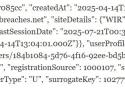
WIRED account information for DataBreaches that Lovely showed her on November 27. It shows email address and date registered and last updated among the fields.
WIRED account information for DataBreaches that Lovely showed her on November 27. It shows email address and date registered and last updated among the fields.
It all seemed consistent with what they had claimed.
Despite its vast wealth, Condé Nast lacks a security.txt file that explains how to report a vulnerability to them. Nowhere on its site did it plainly explain how to report a vulnerability to them.
Trying to help Condé Nast avoid compromise of what was described to me as a serious vulnerability risking more than 33 million users’ accounts, I reached out to people I know at WIRED. I also reached out to Condé Nast but received no replies from them.
When the “Researcher” Really Is Dishonorable
Weeks of failed attempts to get a response from Condé Nast followed and Lovely started stating that they were getting angry and thinking about leaking a database just to get the firm’s attention. Leaking a database? They had assured me they had only downloaded a few profiles as proof. But now they stated they had downloaded more than 33 million accounts. They wrote:
We downloaded all 33 million user’s information. The data includes email address, name, phone number, physical address, gender, usernames, and more.
The vulnerabilities allow us to
– view the account information of every Condé Nast account
– change any account’s email address and password
They also provided DataBreaches with a list of the json files showing the number of user accounts for each publication. Not all publications had all of the types of information.
DataBreaches reached out to Condé Nast again with that information, but again received no reply. A contact at WIRED was able to get the firm’s security team to engage and Lovely eventually told DataBreaches that they had made contact and given the security team information on six vulnerabilities they had found.
Six? How many lies had Lovely told me? Lovely asked me to hold off on reporting until the firm had time to remediate all the vulnerabilities. DataBreaches agreed, for the firm’s sake, but by now, had no doubts that Lovely had been dishonest and she had been “played.”
Eventually, Lovely sent a message that everything had now been remediated. DataBreaches asked, “Did they pay you anything?” And that’s when Lovely answered, “Not yet.” DataBreaches subsequently discovered that they have been leaking data from WIRED on at least two forums, with a list of all the json files they intend to leak. Or perhaps they intend to sell some of the data. Either way, they lied to this blogger to get her help in reaching Condé Nast.
“Regrets, I’ve Had a Few”
At one point when I reached out on LinkedIn seeking a contact at Condé Nast, someone suggested that Lovely wasn’t a researcher but was a cybercriminal and that I was aiding them.
With the clarity of hindsight, he was right in one respect, although I certainly had no indication of that at the outset or even weeks later. But as I replied to him at the time, “I hope I wasn’t helping a cybercriminal, but if Condé Nast found out about a vulnerability that allowed access to 33M accounts, did I harm Condé Nast by reaching out to them, or did I help them?”
I don’t know if Condé Nast verified Lovely’s claims or not about the alleged vulnerabilities. That said, based on what I had been told, I don’t regret my repeated attempts to get their security team to contact Lovely to get information about the alleged vulnerability.
As for “Lovely,” they played me. Condé Nast should never pay them a dime, and no one else should ever, as their word clearly cannot be trusted.
Update of December 27, 2025: By now, the data leak has started to be picked up on LinkedIn by Alon Gal and on Have I Been Pwned by Troy Hunt. Condé Nast has yet to issue any public statement or respond to this site’s inquiries. As HIBP reports:
In December 2025, 2.3M records of WIRED magazine users allegedly obtained from parent company Condé Nast were published online. The most recent data dated back to the previous September and exposed email addresses and display names, as well as, for a small number of users, their name, phone number, date of birth, gender, and geographic location or full physical address. The WIRED data allegedly represents a subset of Condé Nast brands the hacker also claims to have obtained.

In the summer of 2005, Tan Dailin was a 20-year-old grad student at Sichuan University of Science and Engineering when he came to the attention of the People’s Liberation Army of China.
Tan was part of a burgeoning hacker community known as the Honkers—teens and twentysomethings in late-’90s and early-’00s China who formed groups like the Green Army and Evil Octal and launched patriotic cyberattacks against Western targets they deemed disrespectful to China. The attacks were low-sophistication—mostly website defacements and denial-of-service operations targeting entities in the US, Taiwan, and Japan—but the Honkers advanced their skills over time, and Tan documented his escapades in blog posts. After publishing about hacking targets in Japan, the PLA came calling.
The subsequent timeline of events is unclear, but Tan, who went by the hacker handles Wicked Rose and Withered Rose, then launched his own hacking group—the Network Crack Program Hacker (NCPH). The group quickly gained notoriety for winning hacking contests and developing hacking tools. They created the GinWui rootkit, one of China’s first homegrown remote-access backdoors and then, experts believe, used it and dozens of zero-day exploits they wrote in a series of “unprecedented” hacks against US companies and government entities over the spring and summer of 2006. They did this on behalf of the PLA, according to Adam Kozy, who tracked Tan and other Chinese hackers for years as a former FBI analyst who now heads the SinaCyber consulting firm, focused on China.
Tan revealed online at the time that he and his team were being paid about $250 a month for their hacking, though he didn’t say who paid or what they hacked. The pay increased to $1,000 a month after their summer hacking spree, according to a 2007 report by former threat intelligence firm VeriSign iDefense.
At some point, Tan switched teams and began contracting for the Ministry of State Security (MSS), China’s civilian intelligence agency, as part of its notorious hacking group known as APT 41. And in 2020, when Tan was 36, the US Justice Department announced indictments against him and other alleged APT 41 members for hacking more than 100 targets, including US government systems, health care organizations, and telecoms.
Tan’s path to APT 41 isn’t unique. He’s just one of many former Honkers who began their careers as self-directed patriotic hackers before being absorbed by the state into its massive spying apparatus.
Not a lot has been written about the Honkers and their critical role in China’s APT operations, outside of congressional testimony Kozy gave in 2022. But a new report, published this month by Eugenio Benincasa, senior cyberdefense researcher at the Center for Security Studies at ETH Zürich university in Switzerland, expands on Kozy’s work to track the Honkers’ early days and how this group of skilled youths became some of China’s most prolific cyberspies.
“This is not just about [Honkers] creating a hacker culture that was implicitly aligned with national security goals,” Benincasa says, “but also the personal relations they created [that] we still see reflected in the APTs today.”
Early Days
The Honker community largely began when China joined the internet in 1994, and a network connecting universities and research centers across the country for knowledge-sharing put Chinese students online before the rest of the country. Like US hackers, the Honkers were self-taught tech enthusiasts who flocked to electronic bulletin boards (dial-up forums) to share programming and computer hacking tips. They soon formed groups like Xfocus, China Eagle Union, and The Honker Union of China and came to be known as Red Hackers or Honkers, a name derived from the Mandarin word “hong,” for red, and “heike,” for dark visitor—the Chinese term for hacker.

The Scattered Spider hacking group has caused chaos among retailers, insurers, and airlines in recent months. Researchers warn that its flexible structure poses challenges for defense.
Empty grocery store shelves and grounded planes tend to signal a crisis, whether it’s an extreme weather event, public health crisis, or geopolitical emergency. But these scenes of chaos in recent weeks in the United Kingdom, United States, and Canada were caused instead by financially motivated cyberattacks—seemingly perpetrated by a collective of joyriding teens.
A notorious cybercriminal group often called Scattered Spider is known for using social engineering techniques to infiltrate target companies by tricking IT help desk workers into granting them system access. Researchers say that the group seems to gain expertise about the backend systems commonly used by businesses in a particular industry and then uses this knowledge to hit a cluster of targets before moving on to another sector. The group often deploys ransomware or conducts data extortion attacks once it has compromised its victims.
Amid increasing pressure from law enforcement last year, which culminated in charges and arrests of five suspects allegedly linked to Scattered Spider, researchers say that the group was less active in 2024 and seemed to be attempting to lay low. The group’s escalating attacks in recent weeks, though, have shown that, far from being defeated, Scattered Spider is emboldened once again.
“There are some uniquely skilled actors in Scattered Spider when it comes to social engineering, and they have identified a major gap in our security systems that they’re successfully taking advantage of,” says John Hultquist, chief analyst in Google’s threat intelligence group. “This group is carrying out serious attacks on our critical infrastructure, and I hope that we’re not missing the opportunity to address the most imminent threat.”
Though a number of incidents have not been publicly attributed, an overwhelming spree of recent attacks on UK grocery store chains, North American insurers, and international airlines has broadly been tied to Scattered Spider. In May, the UK’s National Crime Agency confirmed it was looking at Scattered Spider in connection to the attacks on British retailers. And the FBI warned in an alert on Friday that it has observed “the cybercriminal group Scattered Spider expanding its targeting to include the airline sector.” The warning came as North American airlines Westjet and Hawaii Airlines said they had been victims of cybercriminal hacks. On Wednesday, the Australian airline Qantas also said it had been hit with a cyberattack, though it was not immediately clear if this attack was part of the group’s campaign.

In an effort to evade detection, cybercriminals are increasingly turning to “residential proxy” services that cover their tracks by making it look like everyday online activity.
For years, gray-market services known as “bulletproof” hosts have been a key tool for cybercriminals looking to anonymously maintain web infrastructure with no questions asked. But as global law enforcement scrambles to crack down on digital threats, they have developed strategies for getting customer information from these hosts and have increasingly targeted the people behind the services with indictments. At the cybercrime-focused conference Sleuthcon in in Arlington, Virginia, today, researcher Thibault Seret outlined how this shift has pushed both bulletproof hosting companies and criminal customers toward an alternative approach.
Rather than relying on web hosts to find ways of operating outside law enforcement's reach, some service providers have turned to offering purpose-built VPNs and other proxy services as a way of rotating and masking customer IP addresses and offering infrastructure that either intentionally doesn't log traffic or mixes traffic from many sources together. And while the technology isn't new, Seret and other researchers emphasized to WIRED that the transition to using proxies among cybercrminals over the last couple of years is significant.

The open source software easyjson is used by the US government and American companies. But its ties to Russia’s VK, whose CEO has been sanctioned, have researchers sounding the alarm.
Security researchers warn that a popular open source tool maintained by Russian developers could pose significant risks to US national security.
Key Points:
The open source tool easyjson is linked to VK Group, a company run by a sanctioned Russian executive.
easyjson is widely used in the US across various critical sectors including defense, finance, and healthcare.
Concerns are heightened due to the potential for data theft and cyberattacks stemming from this software.
*Recent findings from cybersecurity researchers at Hunted Labs indicate that easyjson, a code serialization tool for the Go programming language, is at the center of a national security alert. This tool, which has been integrated into multiple sectors such as the US Department of Defense, is maintained by a group of Russian developers linked to VK Group, led by Vladimir Kiriyenko. While the complete codebase appears secure, the geopolitical context surrounding its management raises substantial concerns about the potential risks involved.
The significance of easyjson cannot be overstated, as it serves as a foundational element within the cloud-native ecosystem, critical for operations across various platforms. With connections to a sanctioned CEO and the broader backdrop of Russian state-backed cyberattacks, the fear is that easyjson could be manipulated to conduct espionage or potentially compromise critical infrastructures. Such capabilities underscore the pressing need for independent evaluations and potential reevaluations of software supply chains, particularly when foreign entities are involved.

Despite their hacktivist front, CyberAv3ngers is a rare state-sponsored hacker group bent on putting industrial infrastructure at risk—and has already caused global disruption.
The intermittent cyberwar between Israel and Iran, stretching back to Israel's role in the creation and deployment of the Stuxnet malware that sabotaged Iran's nuclear weapons program, has been perhaps the longest-running conflict in the era of state-sponsored hacking. But since Hamas' October 7 attack and Israel's retaliatory invasion of Gaza, a new player in that conflict threatens not just digital infrastructure in Israel but also critical systems in the US and around the world.
The group known as CyberAv3ngers has, in the last year and a half, proven to be the Iranian government's most active hackers focused on industrial control systems. Its targets include water, wastewater, oil and gas, and many other types of critical infrastructure. Despite being operated by members of Iran's Revolutionary Guard Corps, according to US officials who have offered a $10 million bounty for information leading to their arrest, the group initially took on the mantle of a “hacktivist” campaign.

Amid ongoing fears over TikTok, Chinese generative AI platform DeepSeek says it’s sending heaps of US user data straight to its home country, potentially setting the stage for greater scrutiny.

InfoCert, uno dei principali fornitori di identità digitale, ha confermato la violazione annunciata sui forum da criminali informatici. I dati rubati potrebbero essere usati per attacchi phishing mirati

Experts say the catchall term for online fraud furthers harm against victims and could dissuade people from reporting attempts to bilk them out of their money.

The scourge of “malvertising” is nothing new, but the tactic is still so effective that it's contributing to the rise of investment scams and the spread of new strains of malware.

I pirati del gruppo RansomHub pubblicano su Dark Web alcuni dei documenti sottratti e chiedono al club di Serie A di pagare un riscatto
In a first, Russia's APT28 hacking group appears to have remotely breached the Wi-Fi of an espionage target by hijacking a laptop in another building across the street.

More than 3 billion phone coordinates collected by a US data broker expose the detailed movements of US military and intelligence workers in Germany—and the Pentagon is powerless to stop it.

A vulnerability categorized as “critical” in a photo app installed by default on Synology network-attached storage devices could give attackers the ability to steal data and worse.

“Passkeys,” the secure authentication mechanism built to replace passwords, are getting more portable and easier for organizations to implement thanks to new initiatives the FIDO Alliance announced on Monday.

It's hard enough creating one air-gap-jumping tool. Researchers say the group GoldenJackal did it twice in five years.

Please don’t, actually. But do update your Shimano Di2 shifters’ software to prevent a new radio-based form of cycling sabotage.
#bicycles #cyberattacks #cybersecurity #cycling #fitness #hacks #security

Researchers warn that a bug in AMD’s chips would allow attackers to root into some of the most privileged portions of a computer—and that it has persisted in the company’s processors for decades.

A team of researchers have developed a method for extracting authentication keys out of HID encoders, which could allow hackers to clone the types of keycards used to secure offices and other areas worldwide.

Not only is TikTok’s algorithm promoting Neo-Nazi content, extremist organizations are also using the platform to recruit new members and encourage real-world action.
#content #extremism #media #moderation #nazis #social #tiktok


